

Last Updated: November 21, 2026
Quick Summary
Most whole roasted coffee beans taste their best for about two to four weeks after the roast date, and they stay safe to drink for longer. Staling affects flavor rather than safety, so beans past their peak are still drinkable. Storing them well keeps more of that freshness.
- Count freshness from the roast date printed on the bag, not the best-by date.
- Beans usually taste most balanced from about day 4 to day 14 after roasting.
- Once opened, use whole beans within one to two weeks for the best cup.
- Store beans in an airtight, opaque container at room temperature, away from heat.
- Freeze beans in small airtight portions, and thaw them sealed to avoid condensation.
Table of Contents
- How Long Roasted Coffee Beans Stay Fresh, Starting From the Roast Date
- Peak Flavor, Gradual Staling and Food Safety: What Each Timeline Means
- How Long Do Whole Coffee Beans Last Once Opened
- How Long Do Roasted Coffee Beans Stay Fresh Unopened
- How to Keep Coffee Beans Fresh for Months: Storage Steps by Packaging Type
- How Long Do Coffee Beans Last in the Freezer, and How to Thaw Them
- Run a Simple Freshness Check Before You Brew
- Setting Up Your Next Bag: Buying and Portioning for Your Brewing Habits
- Frequently Asked Questions
How Long Roasted Coffee Beans Stay Fresh, Starting From the Roast Date
How long do roasted coffee beans stay fresh? Most whole beans taste their best for about two to four weeks after the roast date, and they stay safe to drink for much longer.
Roast date matters more than the "best by" date on most bags. Look for a roast date printed on the packaging.
Here is a simple way to think about the timeline:
- Days 1 to 3 after roasting: Beans release carbon dioxide. Many coffee drinkers let them rest before brewing.
- Days 4 to 14: Flavor is usually at its most balanced.
- Weeks 3 to 4: Aroma and sweetness start to fade.
Roast level changes the timeline. Darker roasts have more exposed oils and tend to go stale a bit faster than light roasts.
Peak Flavor, Gradual Staling and Food Safety: What Each Timeline Means
Many sources mix up three different ideas. Keeping them separate makes the timelines easier to read.
- Peak flavor is when the beans taste the way the roaster intended.
- Gradual staling is the slow loss of aroma and sweetness that comes with air exposure.
- Food safety is whether the beans are safe to eat. Staling affects flavor, not whether the beans are safe to drink.
This means a bag past its peak is still safe. It just tastes weaker. Moisture is the main exception.
Common mistake: people toss stale beans for safety reasons when the real issue is flavor. Try a fresh bag before you give up on a favorite coffee.
How Long Do Whole Coffee Beans Last Once Opened
Once you open a bag, oxygen starts working on the beans faster.
Each time the bag is open to air, freshness drops a little more. Scoop quickly, close the bag tightly and press out extra air when you can.
A practical habit: divide a new bag into two or three smaller containers. Only the one you use daily gets opened often.
How Long Do Roasted Coffee Beans Stay Fresh Unopened
An unopened bag usually keeps its best flavor for a few weeks after the roast date, and sealed packaging helps slow staling.
Always count from the roast date rather than the purchase date.
How to Keep Coffee Beans Fresh for Months: Storage Steps by Packaging Type
The bag your beans arrive in is not just packaging, it is a storage system with specific strengths and limits. Most guides treat all bags as interchangeable and tell you to transfer beans to a canister immediately. In practice, the right move depends on what the packaging is designed to do. Here is how to read the bag and decide.
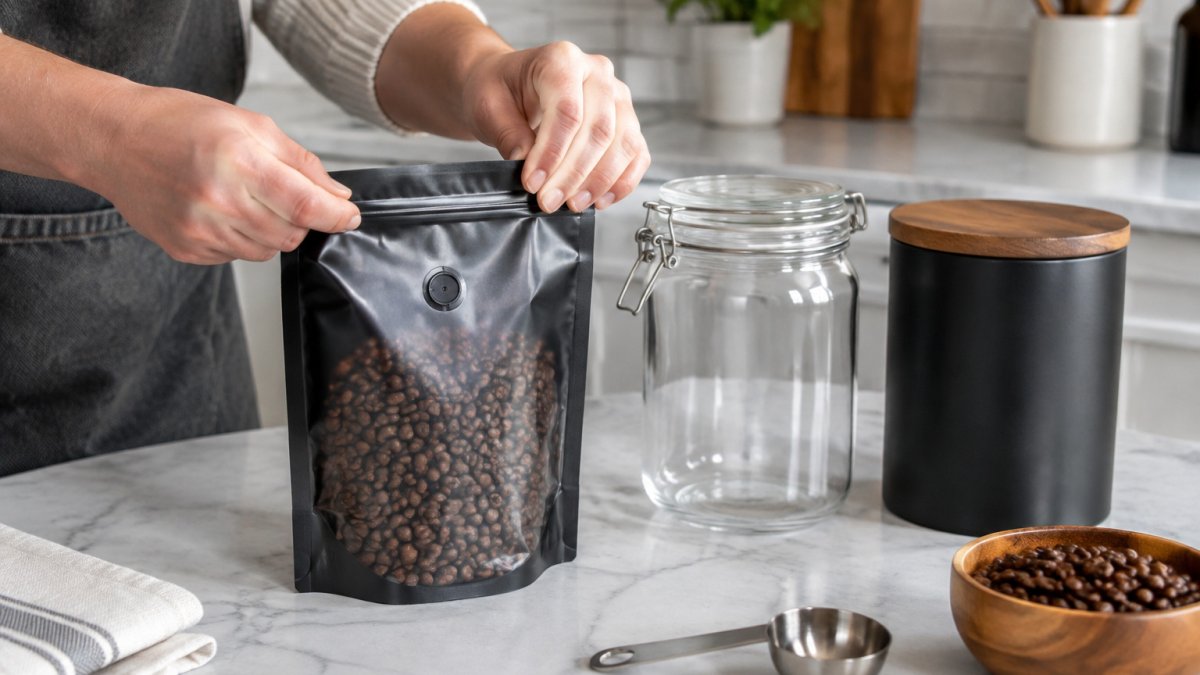
What each packaging type actually does
- One-way valve bags. The valve is a small silicone or plastic membrane that lets carbon dioxide escape as beans degas while blocking most oxygen from entering. This matters most in the first one to two weeks after roasting, when beans release the most gas. A valve bag is a good primary container during that window. Its weakness is the seal: most valve bags are folded or taped, not truly airtight, so once opened they let air in every time you reach for beans.
- Nitrogen-flushed sealed bags. Some roasters replace the air inside the bag with nitrogen before sealing, which slows oxidation before the bag is ever opened. These bags often hold peak flavor slightly longer unopened. Once opened, they behave like any other bag, the nitrogen advantage is gone.
- Resealable zipper bags. Convenient but rarely airtight. The zipper degrades with use, and the bag itself is usually a thin barrier. Fine for the first week or two of daily use, less reliable for longer storage.
When to transfer, and when to leave beans in the original bag
Transfer beans to an airtight container when you plan to keep them longer than about two weeks after opening, or when you are portioning a large bag into smaller daily-use containers.
If the bag has no valve and no resealable closure, transfer immediately to an airtight container, an open fold is not a seal.
A packaging-aware storage routine
- Check the bag for a roast date. Count freshness from the roast date, not the purchase date.
- Keep the original bag sealed and in a dark cabinet for the first week or two. Press out excess air each time you reseal.
- Move to an airtight, opaque canister once daily use begins in earnest or once the bag's closure stops holding.
- Portion large bags into two or three smaller containers so only the container you use daily gets opened repeatedly.
- Store at room temperature, away from the stove, windows, and any heat source. Moisture and heat are the two fastest routes to stale beans.
- Skip the refrigerator for daily storage. Condensation from repeated temperature changes does more damage than room-temperature air.
Storage comparison: bag, canister, jar or freezer
| Storage method | Best for | Protects against | Main drawback |
|---|---|---|---|
| Original bag with valve | First one to two weeks after opening | Oxygen ingress, some light | Seal weakens with use; not airtight |
| Nitrogen-flushed sealed bag | Unopened storage | Oxygen before opening | Advantage ends once opened |
| Airtight canister | Daily use after opening | Air, light, moisture | Needs a true gasket seal |
| Glass jar | Short-term, dark-cabinet storage | Air if sealed well | Lets in light unless stored dark |
| Freezer (sealed portions) | Months of storage | Air, heat, humidity | Requires careful thawing |
Matching packaging to your consumption rate
If you finish a bag within two weeks, the original valve bag plus a quick reseal is usually enough. If a bag lasts three to four weeks, transfer to an airtight canister after the first week. If you buy in bulk or drink slowly, portion into smaller containers or freezer bags on day one and store the rest sealed, packaging strategy should follow how fast you actually brew, not a single universal rule.
How Long Do Coffee Beans Last in the Freezer, and How to Thaw Them
Freezing can help hold roasted beans for longer than room-temperature storage. Whole beans frozen in airtight portions soon after roasting can keep their flavor for a longer period, and remain drinkable beyond that. The catch is that freezing only works when you control two things: moisture and repeated temperature swings.
Why freezing works, and where it goes wrong
Below freezing, the chemical reactions that stale coffee, oxidation of oils and loss of volatile aroma compounds, slow dramatically. The beans are not damaged by cold itself. They are damaged by condensation.
Repeated freeze-thaw cycles are the other failure mode. Each thaw-and-refreeze cycle pushes moisture in and out of the bean and degrades cell structure, so a bag that has been thawed and refrozen three times will taste noticeably flatter than one frozen once.
Step-by-step freezing protocol
- Portion by use, not by bag. Divide the bag into amounts you will brew within about a week, typically 5 to 7 ounces for a one-cup-a-day drinker, or single espresso doses if you pull shots. Small portions thaw fast and never sit half-used.
- Use the right container. A vacuum-sealed bag, a resealable freezer bag with the air pressed out, or a small airtight canister all work. The original bag with a one-way valve is acceptable if you squeeze out excess air and seal it well; the valve is not a substitute for an airtight seal in the freezer.
- Label with the roast date and freeze date. Freshness still counts from the roast date, not the freeze date, so write both.
- Freeze flat and fast. Lay portions flat so they freeze through quickly and stack efficiently. Place them away from the freezer door, where temperature fluctuates most.
- Thaw in the sealed container. Move one portion to the counter and let it come to room temperature for about 30 to 60 minutes before opening. Do not open the container while the beans are still cold.
- Grind and brew immediately after opening. Once thawed and opened, treat the portion like any opened bag: use it within about a week.
Watch out: opening a cold bag is the single most common freezing mistake. The rush of warm air onto cold beans creates condensation inside the bag, and that moisture stales the coffee faster than room-temperature storage would have.
Freezer myths worth retiring
- "Freezing makes beans go stale faster." Only if moisture gets in or the beans are repeatedly thawed and refrozen. A properly sealed, single-thaw portion holds up well.
- "You can freeze ground coffee." You can, but ground coffee has far more surface area exposed to oxygen, so it stales faster before and after freezing. Freeze whole beans and grind after thawing.
- "Refrigerator is the same as freezer." It is not. A refrigerator cycles through warm and cold, is humid, and exposes beans to food odors. For daily storage, keep beans at room temperature; for long storage, use the freezer.
How long frozen beans actually last
There is no official shelf-life standard for frozen roasted coffee, so treat these as practical windows rather than rules. For peak flavor, aim to use frozen portions within a few months. Beyond six months, beans are still safe to brew but typically taste muted and flat. If you freeze a bag you already opened and left on the counter for two weeks, expect the frozen result to taste like two-week-old coffee, not fresh coffee, freeze early for the best outcome.
Run a Simple Freshness Check Before You Brew
You can test beans without special equipment:
- Smell the beans. A sweet, fruity, or chocolatey aroma suggests they are still fresh. A flat or cardboard smell means they are past their best.
- Brew a small test cup and compare it to a fresher batch if you have one.
- Check for moisture, oil that is not from the roast, or any mold. If you see any of these, do not drink them.
Keep a note of roast dates on each bag so the test has context.
Setting Up Your Next Bag: Buying and Portioning for Your Brewing Habits
Match the bag size to how much coffee you drink.
Pricing depends on quantity, roast, and delivery options. Check RISE COFFEE CO.'s website for current prices and shipping details.
Plan your next order around your last bag.
Freshness differs by brewing method too. Espresso shows staleness quickly, so buy smaller amounts for it.
For the best cup, buy fresh roasts, store them well and use them within a few weeks.
Frequently Asked Questions
Can I still use 2-year-old coffee beans?
Coffee roasted two years ago is usually safe to drink but will taste flat, dusty or cardboard-like. Roasted beans reach peak flavor within a few weeks of the roast date and then gradually lose aroma as their volatile compounds and oils oxidize. Food safety is rarely the issue; flavor is. If the beans smell rancid, sour or musty, or show visible mold, discard them. Otherwise you can brew them, though you will get a much better cup from fresher beans.
Is coffee roasted four months ago still good?
Coffee roasted four months ago is generally past its best. Most whole beans stay at peak flavor for roughly two to four weeks after roasting, and a well-sealed, properly stored bag may still taste acceptable at four months, but aroma and sweetness will be noticeably reduced. Check the roast date on the bag. If you cannot find one, judge by smell: fresh beans have a strong, complex aroma, while stale beans smell faint or woody.
How long do roasted coffee beans stay fresh after opening?
Once opened, whole beans are best used within about one to two weeks, with the most noticeable decline after the first week because oxygen and humidity reach the beans every time the bag is opened. Reseal the bag tightly after each use, press out excess air, and store it away from heat and light. Ground coffee goes stale much faster, often within a few days, so grind only what you will brew.
What is the 15-15-15 coffee rule?
The 15-15-15 rule is a simple guideline for judging whether coffee is still worth brewing: it suggests coffee is best within 15 days of roasting, that it should be stored at around 15 degrees Celsius, and that you should brew within 15 minutes of grinding. It is a rough rule of thumb rather than a scientific standard, but it captures the core point that freshness depends on time since roasting, storage conditions and time since grinding.
